

2026 is not over, but at the moment it seems likely that it will go down in history as the year Artificial Intelligence (AI) went mainstream. AI is now widely available at little or no cost and the many ways it can be a part of our personal and professional lives are becoming more evident by the day.
The live events industry, as reliant on people power as it is, does not function apart from this. Rhino management personnel has had the Pro version of Google’s Gemini at its disposal for months and has been actively integrating it into their workflows. Our thinking and approach to this has been informed, in part, by Geoff Woods’ book The AI-Driven Leader. Copies of it have been circulating within our ranks and it has prompted, pun intended, heightened awareness and use of AI within the company.
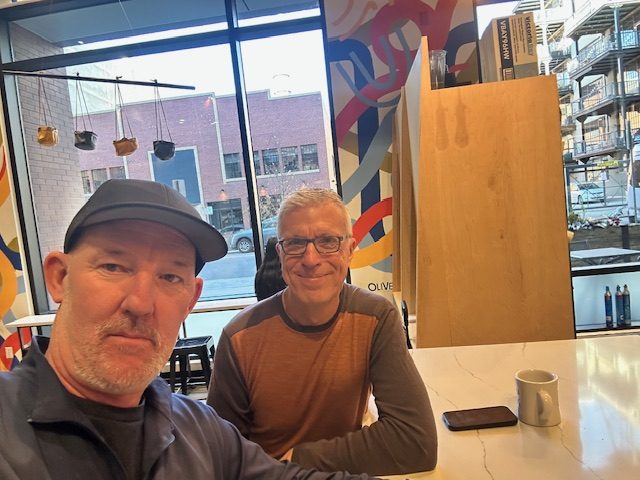
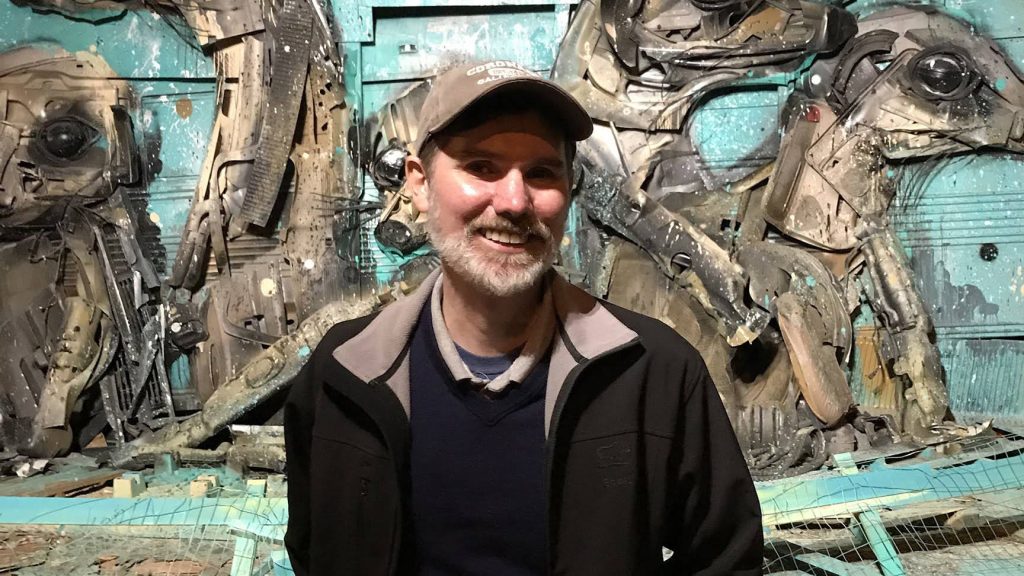
To find out how AI adoption has been transpiring within our ranks, we put a series of questions about AI usage and Wood’s book to two of our early adopters, Floyd Dillman, Board of Directors Advisory Committee for Rhino’s parent company Program Productions, and Boone Jackson, Rhino Staging’s National Director of Safety.
Q: What was your first introduction to AI and what were your feelings then about the prospect of using it at work?
Floyd: I heard about Chat GPT for a long time, but I didn’t know anyone who was using it, and I assumed it was tough to manage and would take too long to learn to be effective. But as AI development accelerated, I started playing with Claude and the learning curve was not as steep as expected, and the productivity boost coming from having an editor and a financial analyst on my desktop made me a believer.
Boone: I first experienced AI seeing it utilized in movie trailers on YouTube though I did not give it much thought other than I recognized it as AI. I have been known for my ability to write heartfelt essays concerning work ethic and leadership. Feedback on one of these essays was that it sounded as if it was written by AI. To hear that something I put time, experience, and sincerity into drafting was indistinguishable from what a machine could produce felt like a reverse Turing test which made me initially hesitant to work with AI. Once I began utilizing AI, I learned how to use it as a tool maintaining my distinct voice.
Q: What has been your experience in introducing it into your workflows and what are some examples of how you have put it to use?
Floyd: I use it as if it were my assistant (or even a highly paid expert) for a variety of applications including:
- Uploading financial reports and using AI to create analysis, comparisons, or to pose a hypothesis and ask the AI to review financials to see if I’m on track.
- Describing an operational issue to AI and asking it to interview me, then use writing I upload and its insight to build options for response.
- Exploring various employment law and other legal scenarios in service to discovering the most favorable path to bring a brief, well-founded question to an attorney for discussion and validation – saving money on legal fees and the time of the attorneys, especially when some ideas go nowhere.
- When I do research, I tend to create lengthy reports with more detail than people are willing to read – now I feed the report into AI and ask for a 1-2 page executive summary with the takeaways at the top. And that’s what I circulate to the execs who have limited time and focus.
Boone: I utilize it quite often especially when working towards a solution for which I’m not sure where to start researching. By having a conversation with AI, I’m guided to reference materials as well as resources I might not have considered in my problem-solving process.
Q: Have you become an AI “evangelist” amongst your colleagues?
Floyd: Not really, but I’m happy to talk about it.
Boone: I wouldn’t say I proselytize its use, but I do encourage interacting with it while attesting to how I’ve found it helpful.
Q: Is AI a particularly viable tool for live event production pros and have you found that your peers in the industry are generally hesitant or eager to adopt A.I. for their work purposes?
Floyd: I haven’t used it for any truly live production work, but for business it works for me. I am not sure how people are adopting it – or not.
Boone: I have found it to be a valuable tool in making the time I spend researching solutions more efficiently used. It has also been instrumental in helping me create graphics to communicate complex ideas such as safety videos I’ve produced on how forklifts are like bulls in a china shop or the amount of force a road case can exert when striking an immovable object. I think adoption of its use is still slow as it is a different approach to doing tasks that we’ve all been conditioned to do a certain way. Early adopters will have the advantage over those who will eventually have to play catch up.
Q: A concern with AI is that it will “dumb us down” by allowing us to essentially outsource our critical thinking. Is this a valid concern and, if so, how are you taking care to avoid that pitfall?
Floyd: So far I’ve learned that the AI may draw conclusions based on data that does not apply to my situation, and the solution is that I need to think more clearly and give the AI an abundance of information – too much information even, then carefully read the output and challenge what I think is incorrect. A lot of the value for me and the AI comes in the interviews and conversations and I think that I’m getting smarter through the work.
Boone: That concern is definitely a pitfall. Recently a college professor exemplified this by putting text only AI could read into a midterm assignment. He identified those using AI as it put in references to “Madagascar” into their essays. There will always be people who find a way to misuse something made with good intentions to use as a shortcut. The best way to avoid the pitfall is to “trust but verify”. AI is pulling from sources all over the internet and it may pull from a source with incorrect information. Ask for sources in AI responses, and check them.
Part II of this interview coming soon.